


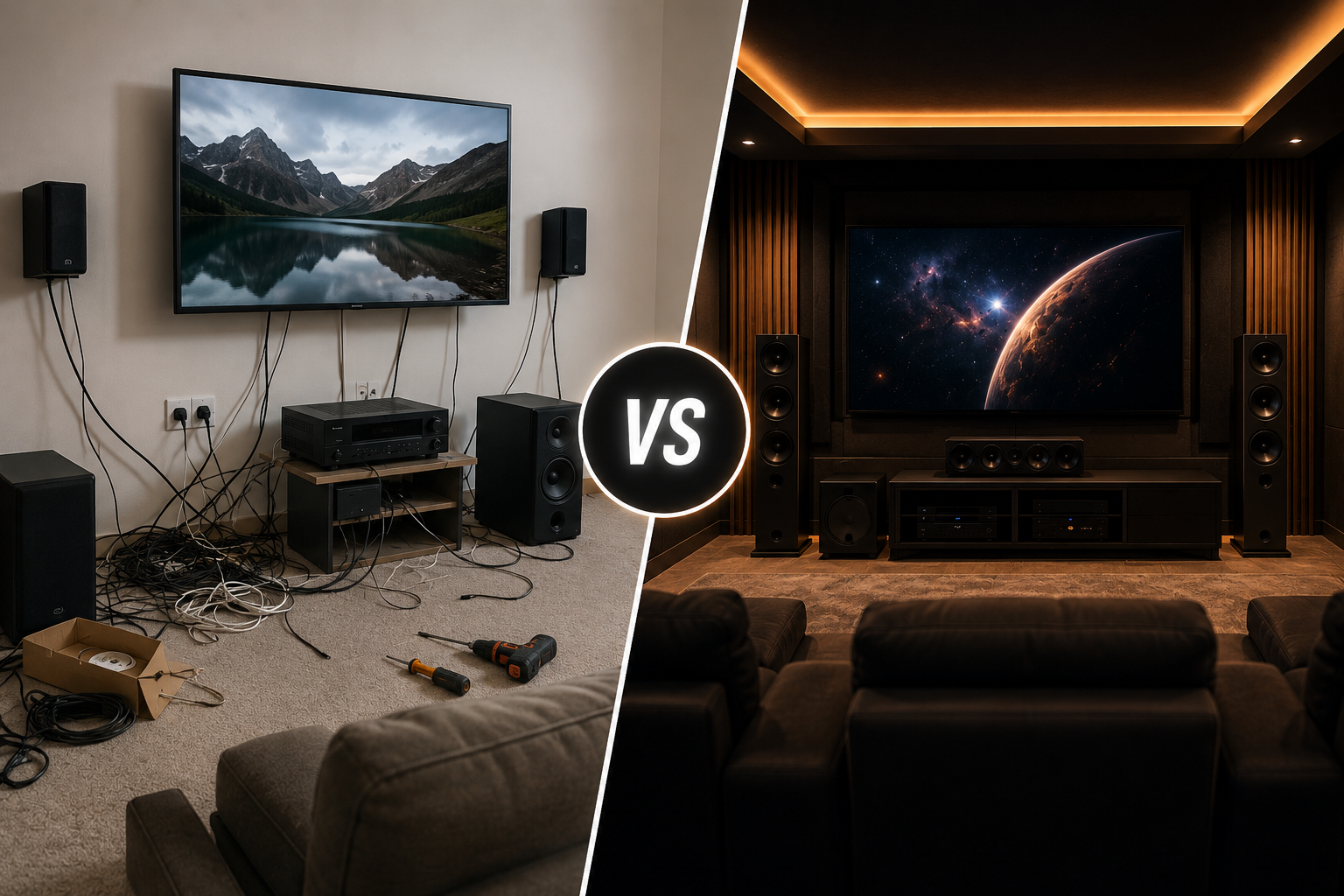
Professional vs DIY Home Theatre Installation: Which Is Better for Your Home?
Building a home theatre is no longer reserved for luxury mansions or dedicated cinema rooms. Today, homeowners across India are investing in immersive entertainment spaces that bring movies, sports, gaming, and music to life.
However, once you've selected your speakers, projector, television, or AV receiver, another important question arises:
Should you install your home theatre yourself, or hire a professional home theatre installation company?
At first glance, DIY installation may seem like an excellent way to save money. After all, there are countless online tutorials, setup videos, and product manuals available.
But a home theatre is much more than connecting speakers and turning on a television.
Speaker placement, room acoustics, calibration, wiring, viewing angles, lighting control, and future scalability all influence the final experience.
In this guide, we'll compare DIY and professional home theatre installation, uncover common mistakes homeowners make, and help you determine which approach offers the best long-term value.
Why More Homeowners Are Investing in Home Theatres
Modern entertainment has evolved significantly.
Today, homeowners enjoy:
- Netflix
- Prime Video
- Disney+ Hotstar
- Apple TV+
- Gaming consoles
- Dolby Atmos content
- High-resolution music streaming
As display technologies improve, many homeowners quickly realise that great visuals alone aren't enough.
Without proper audio, even the most expensive television cannot deliver a truly immersive experience.
This is why professionally designed home theatres and media rooms continue to gain popularity among homeowners, architects, and interior designers.
Working with an experienced Home Theatre Company in India ensures the entire room is designed around performance rather than just equipment specifications.
What Is DIY Home Theatre Installation?
DIY home theatre installation involves designing, purchasing, configuring, and installing the entire entertainment system yourself.
Typical DIY projects include:
- Mounting televisions
- Installing speakers
- Running cables
- Connecting AV receivers
- Configuring source devices
- Basic audio calibration
For technically inclined homeowners, DIY installation can be rewarding and educational.
Advantages of DIY Installation
Lower Initial Cost
The most obvious benefit is avoiding installation charges.
Greater Personal Involvement
Many enthusiasts enjoy learning about audio and video technologies.
Flexible Timeline
You can work at your own pace and make adjustments whenever required.
Suitable for Simple Systems
Basic soundbar setups or entry-level 3.1 systems can often be installed successfully by homeowners.
Limitations of DIY Installation
While DIY may seem attractive, it often introduces challenges that affect performance.
Common issues include:
- Poor speaker placement
- Incorrect subwoofer positioning
- Cable visibility
- AV receiver misconfiguration
- Acoustic problems
- Uneven sound distribution
- Inadequate Dolby Atmos performance
These mistakes can significantly reduce the performance of even premium equipment.
What Is Professional Home Theatre Installation?
Professional installation goes far beyond mounting speakers and connecting cables.
A professional installer evaluates:
- Room dimensions
- Seating layout
- Acoustic behaviour
- Display positioning
- Lighting conditions
- Equipment compatibility
- Future upgrade requirements
The objective is not simply to install equipment but to create an optimized entertainment environment.
Professional Custom Home Theatre Installation focuses on delivering the best possible performance from every component in the room.
DIY vs Professional Home Theatre Installation: Quick Comparison
| Feature | DIY Installation | Professional Installation |
| Initial Cost | Lower | Higher |
| Expertise Required | High | Minimal |
| Speaker Placement | Trial & Error | Optimized |
| Dolby Atmos Setup | Challenging | Accurate |
| Acoustic Planning | Usually Ignored | Included |
| Calibration | Basic | Advanced |
| Cable Management | Variable | Clean & Hidden |
| Smart Home Integration | Limited | Seamless |
| Long-Term Performance | Inconsistent | Optimized |
| Future Scalability | Often Overlooked | |
| Planned |
7 Costly Mistakes Homeowners Make During DIY Installation
Most DIY failures aren't caused by equipment.
They're caused by planning mistakes.
1. Incorrect Speaker Placement
Speaker positioning is critical.
Even expensive speakers can sound underwhelming when placed incorrectly.
Common mistakes include:
- Surround speakers too close
- Centre speaker positioned incorrectly
- Front speakers too narrow
- Improper listening triangle
2. Poor Subwoofer Placement
Bass performance depends heavily on room interaction.
Placing a subwoofer in the wrong location can create:
- Bass nulls
- Excessive boominess
- Uneven low-frequency response
3. Ignoring Room Acoustics
Many homeowners assume equipment alone determines sound quality.
In reality, room acoustics often contribute significantly to overall performance.
Hard surfaces create:
- Echo
- Reflections
- Dialogue clarity issues
4. Incorrect Dolby Atmos Placement
One of the most common mistakes involves Atmos speakers.
Improper positioning can completely eliminate height effects.
5. Poor Cable Planning
Visible cables can ruin even the most beautiful entertainment room.
Retrofitting concealed wiring later can become expensive and disruptive.
6. Improper Projector Alignment
Projector placement affects:
- Image geometry
- Sharpness
- Brightness
- Viewing comfort
Mistakes often require costly corrections.
7. AV Receiver Misconfiguration
Modern receivers contain dozens of settings.
Incorrect configuration can affect:
- Speaker timing
- Channel levels
- Crossover frequencies
- Surround processing
Many homeowners never unlock the full performance potential of their systems.
The Hidden Cost of DIY Installation
DIY installation often appears cheaper initially.
However, hidden costs frequently emerge later.
Examples include:
Rewiring Walls
Incorrect cable planning may require civil work after installation.
Equipment Replacement
Improper wiring can damage sensitive electronics.
Acoustic Corrections
Many homeowners eventually invest in acoustic treatments after realizing the room sounds poor.
Upgrade Limitations
Lack of planning often restricts future system expansion.
In many cases, professional installation becomes necessary after a failed DIY attempt, increasing overall costs.
Why Room Acoustics Matter More Than Equipment
This is perhaps the most overlooked aspect of home theatre design.
Many homeowners spend lakhs on equipment but ignore the room itself.
A professionally designed home theatre often incorporates:
- Acoustic wall treatments
- Fabric panel systems
- Diffusion elements
- Bass traps
- Acoustic ceilings
These features help control reflections and improve:
- Dialogue clarity
- Surround effects
- Bass performance
- Overall immersion
Even premium speakers cannot perform at their best in a poorly treated room.
Professional Home Theatre Installation Process Explained
Many homeowners are surprised to learn how much planning goes into a professional installation.
Step 1: Requirement Analysis
Understanding:
- Content preferences
- Room usage
- Budget
- Performance expectations
Step 2: Room Assessment
Evaluating:
- Room dimensions
- Construction materials
- Seating layout
Step 3: System Design
Selecting:
- Speakers
- Displays
- AV receivers
- Projectors
Step 4: Wiring & Infrastructure Planning
Designing concealed cable pathways.
Step 5: Acoustic Planning
Identifying reflection points and treatment opportunities.
Step 6: Installation
Equipment installation and integration.
Step 7: Calibration
Optimizing:
- Audio levels
- Delay settings
- Frequency response
- Display performance
Step 8: Final Testing
Ensuring the entire system performs as intended.
Real Project Example: Luxury Home Cinema Installation
Project Overview
Property Type: Luxury Villa
Room Size: 320 sq. ft.
Client Requirement:
- Dedicated Dolby Atmos cinema
- Sports viewing
- Gaming
- Music listening
Challenge
The room featured reflective marble surfaces and an open ceiling design.
Solution
Our team implemented:
- Acoustic wall treatments
- Dedicated Atmos channels
- Professional calibration
- Concealed cable infrastructure
Result
The homeowner achieved a cinema-quality experience with immersive surround sound and exceptional dialogue clarity.
Without professional planning, many of these performance benefits would have been impossible to achieve.
DIY vs Professional Installation for Different Types of Homes
Apartments
DIY may be sufficient for:
- Soundbars
- Basic speaker systems
Professional installation becomes beneficial for:
- 5.1 systems
- Dolby Atmos setups
- Concealed wiring
Villas
Professional installation is strongly recommended due to:
- Larger room sizes
- Acoustic considerations
- Infrastructure planning
Dedicated Home Cinemas
Professional installation is essential.
These rooms require:
- Acoustic design
- Speaker positioning
- Advanced calibration
- System integration
Smart Home Integration: A Major Advantage of Professional Installation
Modern entertainment spaces are no longer isolated systems.
Today's homeowners increasingly integrate:
- Lighting
- Curtains
- Climate control
- Security systems
- Voice assistants
Professional Residential AV Solutions allow all these elements to work together seamlessly.
Imagine pressing a single button and automatically:
- Dimming lights
- Closing curtains
- Activating the projector
- Starting your movie
This level of automation is difficult to achieve through DIY installation.
Choosing the Right Home Theatre Equipment
Many homeowners focus on installation before selecting the right equipment.
Brand selection remains equally important.
If you're comparing options, our guide on Which Home Theatre Brand Is Best explores leading manufacturers and their ideal use cases.
Popular brands include:
- JBL
- Bose
- Klipsch
- Yamaha
- Denon
- Marantz
- KEF
Each offers different strengths depending on room size, listening habits, and budget.
Popular Options for Different Budgets
Entry-Level Buyers
If you're exploring affordable audio solutions, our guide on JBL Home Theatre Price ₹5,000 to ₹10,000 covers some budget-friendly options available in the market.
Premium Living Room Systems
A Bose 5.1 Home Theatre System remains a popular choice for homeowners seeking a balance between aesthetics and performance.
Dedicated Cinema Enthusiasts
For larger spaces, understanding the Bose 7.1 Home Theatre Price in India can help buyers evaluate premium surround sound configurations.
Long-Term ROI: DIY vs Professional Installation
Many homeowners focus solely on installation costs.
The smarter question is:
Which option delivers better value over the next 10 years?
Professional installation often provides:
- Better performance
- Higher equipment lifespan
- Easier upgrades
- Better aesthetics
- Fewer mistakes
- Greater property value
For premium homes, professional installation frequently delivers a better long-term return on investment.
When DIY Installation Makes Sense
DIY may be suitable if:
✔ You are technically experienced
✔ You have a simple setup
✔ You are installing a soundbar
✔ You are comfortable troubleshooting issues
✔ Your room requires minimal customization
When Professional Installation Is Worth Every Rupee
Professional installation is highly recommended if:
✔ You're investing over ₹1 lakh
✔ You're building a dedicated media room
✔ You want Dolby Atmos
✔ You need concealed wiring
✔ You want acoustic optimization
✔ You plan to integrate automation
✔ You expect cinema-quality performance
Final Verdict: Professional vs DIY Home Theatre Installation
DIY installation can work well for simple entertainment setups and technology enthusiasts who enjoy hands-on projects.
However, as systems become more sophisticated, the importance of professional planning, acoustic design, calibration, and integration increases dramatically.
A home theatre is not simply a collection of speakers and screens.
It's an ecosystem where room design, acoustics, equipment selection, and installation quality all influence the final experience.
For homeowners seeking the best possible performance, professional installation remains the most reliable path to creating a truly immersive entertainment environment.
The goal isn't just to install equipment.
It's to create an experience that transforms the way you watch, listen, and enjoy entertainment at home.
Frequently Asked Questions
Is professional home theatre installation worth it?
Yes. Professional installation ensures proper speaker placement, calibration, wiring, and acoustic optimization, resulting in significantly better performance.
Can I install a home theatre system myself?
Simple systems can often be installed successfully by homeowners. More advanced Dolby Atmos and surround sound systems benefit greatly from professional expertise.
How much does professional home theatre installation cost in India?
Costs vary based on room size, system complexity, wiring requirements, and acoustic treatments.
Do professionals calibrate home theatre systems?
Yes. Calibration is one of the most valuable aspects of professional installation and helps maximize performance.
Why does speaker placement matter?
Correct placement affects dialogue clarity, surround effects, soundstage width, and overall immersion.
What is the biggest DIY home theatre mistake?
Improper speaker placement and ignoring room acoustics are among the most common and costly mistakes.
Comments (0)
No comments yet. Be the first to share your thoughts!
Leave a Comment