


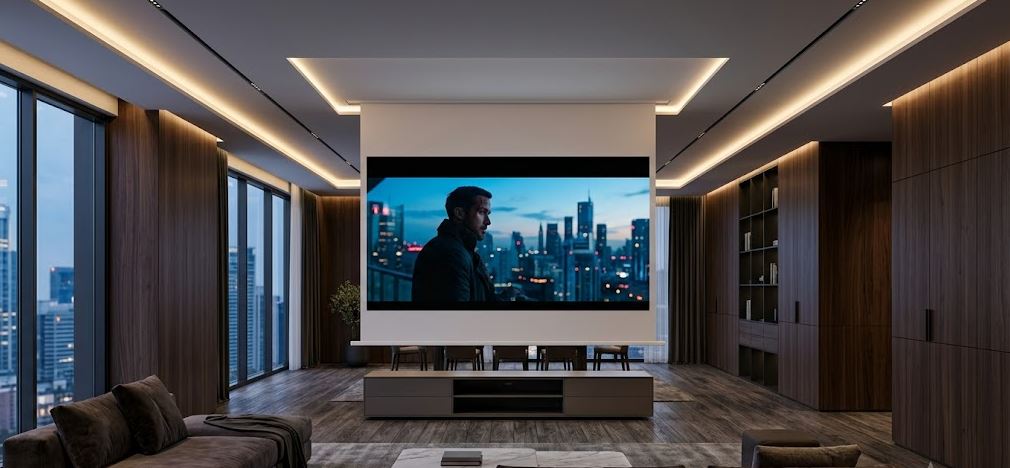
If you’ve ever walked into a high-end living room or a modern boardroom and wondered where the screen was—until a 130-inch display smoothly dropped from the ceiling—you’ve seen a motorized setup done right.
Fixed-frame screens are great for dark, dedicated home theatre rooms where the wall isn't used for anything else. But in multi-purpose living rooms, double-height villas, or corporate conference spaces, hanging a massive black frame permanently on the wall ruins the interior design.
A motorized screen gives you the best of both worlds: complete stealth when you’re not using it, and a razor-sharp, cinema-grade display the moment you press a button. Whether you are setting up a home theatre or configuring a motorized screen for projector integration in a commercial boardroom, automated screens adapt to your space without taking over the room.
At Nanotheatre, we don't just sell screens off a shelf. We specify, design, and install automated projection systems matched precisely to your room's dimensions, lighting conditions, and architectural layout.
Why Choose a Retractable System?
If you've ever used a cheap manual pull-down screen, you know the pain: the fabric pulls unevenly, waves start showing up in the middle, and within six months, the edges start curling inward.
A high-quality motorized retractable projector screen uses a calibrated internal motor and balanced tension weights to pull the fabric down evenly every single time.
- Architectural Stealth: Mount it on the wall, attach it to exposed beams, or completely hide the casing inside a false ceiling drop. When retracted, the room belongs to your architecture again.
- Smart Home Integration: You don't even need a separate remote. Using a 12V trigger or smart home controller (Crestron, Control4, Alexa), the screen drops automatically the second you turn your projector on, and retracts when you turn it off.
- Fabric Protection: Because the screen rolls back up into a sealed casing when not in use, it stays safe from dust, accidental bumps, children, and pets.
Ceiling vs. Wall Installation
Choosing where and how to mount your screen dictates how seamless your room looks when the screen is retracted:
- Motorized Ceiling Projector Screen (In-Ceiling Recessed): The cleanest architectural option available. The entire casing mounts flush inside a false ceiling drop, leaving only a thin, neat flap visible. Lower the screen when needed, and retract it completely out of sight when finished.
- Wall / Exposed Surface Mounting: Ideal for retrofit projects or spaces without false ceilings. Compact, modern aluminum casings ensure the unit blends cleanly into the wall or beam architecture.
Tab-Tensioned vs Non-Tensioned: Don't Make This Mistake
This is where most buyers accidentally ruin their projection quality.
1. Non-Tensioned Screens
These rely purely on a weighted bar at the bottom to pull the fabric down. They work fine for standard 1080p corporate presentations where basic text and slides are being shown. But for home theatre movies, the fabric will eventually develop subtle waves.
2. Tab-Tensioned Screens (Essential for 4K & UST)
Tab-tensioned screens have flexible cables running down both sides of the fabric. These cables pull the screen horizontally while the bottom bar pulls it vertically. The result? A surface as flat as a sheet of glass.
If you are running a 4K projector or an Ultra-Short Throw (UST) projector, a tab-tensioned screen is 100% mandatory. Without it, the angled light hitting the screen will magnify every tiny ripple in the fabric into a distorted image.
Quick Comparison: Budget vs. Premium Setup
| Feature | Standard Budget Screen | Nanotheatre Spec Motorized Screen |
| Motor Noise | Loud, grinding mechanical whine | Silent high-torque tubular motor (<45dB) |
| Surface Flatness | Prone to edge-curl over time | Tab-Tensioned for flat 4K/8K playback |
| Installation | Bulky box visible on wall | Flush recessed in-ceiling casing |
| Control System | Basic wall switch | 12V Auto-Trigger, RF Remote, RS485 Automation |
| Material Types | Basic White PVC | ALR (Daylight view) or Acoustically Transparent |
Choosing the Right Fabric for Your Space
A screen isn't just a piece of white cloth. The material dictates how your projector performs:
- Ambient Light Rejecting (ALR): Designed specifically for living rooms with windows or lights on. ALR screen material reflects the projector's light back to your eyes while absorbing light coming from the sides and ceiling.
- Acoustically Transparent (AT): Micro-perforated or woven fabric that lets sound pass right through it. This allows us to hide your center channel and front speakers directly behind the screen—just like in a commercial multiplex—so dialogue comes straight out of the actors' mouths.
- High Gain Matte White: Best for completely dark, light-controlled home theatre rooms with dedicated ambient lighting control.
Understanding Pricing & Investment
When evaluating the motorized projector screen price, size is only one factor. The overall motorized projector screen cost depends on three core technical elements:
- Screen Material Technology: Standard matte white fabric is budget-friendly, whereas specialized ALR (Ambient Light Rejecting) materials or Acoustically Transparent fabrics cost more due to precise optical layer manufacturing.
- Tensioning Mechanism: Non-tensioned models offer lower entry costs, but a Tab-Tensioned mechanism adds precision cables and heavy roller bars to ensure the flat surface required for 4K and UST projection.
- Motor & Automation Controls: High-torque, silent tubular motors with 12V triggers, RS485 ports, or smart home integration deliver silent operation and long-term reliability.
Evaluate your screen selection as a key optical component of your entire display setup rather than treating it as an isolated accessory.
Real-World Applications
- Living Rooms & Farmhouses: Keep your art wall or TV intact. When it’s movie night, drop a 150-inch motorized screen right in front of it.
- Corporate Boardrooms & Auditoriums: Combine presentation controls so that clicking "Start Meeting" dims the lights, lowers the blind, and drops the screen simultaneously.
- Multi-Purpose Halls & Training Spaces: Keep the floor space completely clear when presentations aren't happening.
Frequently Asked Questions
1. How much false ceiling space do I need for an in-ceiling screen?
Typically, you need about 6 to 10 inches of vertical clearance inside the false ceiling, depending on the screen size and casing dimensions.
2. What is a 12V trigger?
It’s a small cable running between your projector and the screen’s motor controller. Turning on the projector automatically triggers the screen to drop—no extra remotes needed.
3. Can I use a motorized screen with a laser UST projector?
Yes, but you must choose a UST-specific Tab-Tensioned ALR screen. UST projectors shoot light upward at an extreme angle, so standard non-tensioned screens will cause visible distortion.
4. Does Nanotheatre handle installation and automation setup?
Yes. Nanotheatre provides end-to-end guidance, custom sizing, material selection, and integration support for both residential and commercial projects.
Get Your Room Specced Right the First Time
Choosing the wrong screen material, motor type, or size leads to washed-out colors, wavy images, and expensive re-work after your ceiling is already closed.
Nanotheatre designs custom motorized projection setups tailored to your room's exact dimensions, light levels, and interior layout across India.
Use our free 3D Theatre Planning Tool to visualize your space, or talk directly with a Nanotheatre AV specialist for a room-specific recommendation.
Comments (0)
No comments yet. Be the first to share your thoughts!
Leave a Comment