

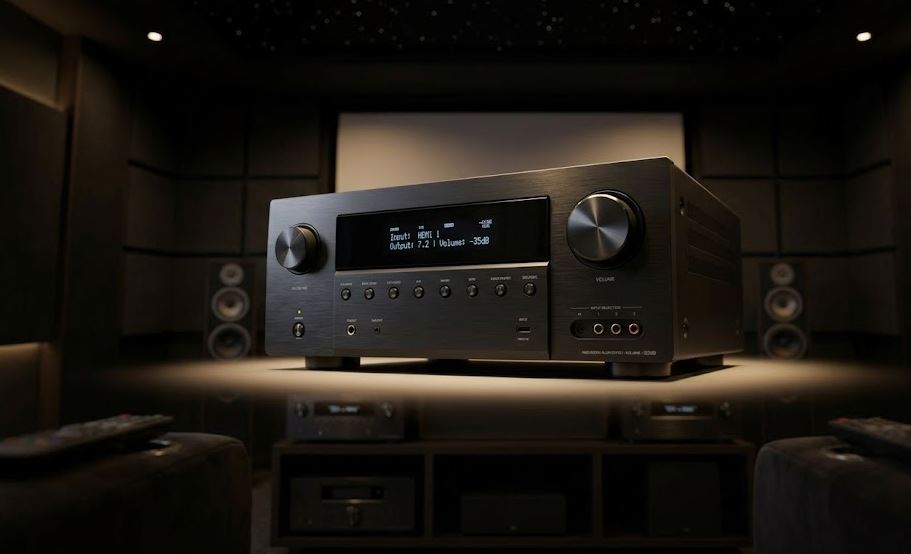
A friend recently asked a simple question: “I already have a good television and speakers. Do I really need to spend more money on a receiver?”
It is a fair question. When you are putting together a home theatre, there are already plenty of things to consider, from the screen and speakers to the seating and room arrangement. The receiver can feel like just another expense. But it plays an important role in bringing the entire system together.
An av receiver connects your entertainment devices, handles audio processing, and sends sound to the speakers. The challenge is not finding a receiver with the longest feature list. It is finding one that makes sense for your room, equipment, and budget.
First, Think About How You Watch Movies
Not everyone uses a home theatre in the same way. Some people watch a film on the weekend, while others spend hours watching series, listening to music, or playing games. Your habits should influence what you buy.
For a basic living-room setup, a straightforward receiver may be enough. A dedicated cinema room with several speakers is a different story. It may need more channels, additional connectivity, or support for advanced surround-sound formats.
This is also why the most expensive model is not always the best purchase. If you will never use half its features, spending extra may not improve your everyday experience.
The Sound Depends on More than the Receiver
A receiver cannot fix every problem in a home theatre. Poor speaker placement, a room with too much echo, or speakers that do not suit the space can affect the final result.
An av amplifier needs to be compatible with the speakers it powers. Check the speaker specifications and the receiver's power ratings before buying. It is also worth considering where the equipment will sit, because receivers need enough ventilation to operate properly.
For movie fans, Dolby Atmos may be worth exploring. A dolby atmos receiver supports compatible soundtracks that can create a more immersive listening experience when paired with the right equipment. DTS is another format to consider; a dts x receiver can play compatible content, depending on the model's supported features.
Neither format guarantees an impressive result on its own. The speaker arrangement and room still matter.
Is It Worth Paying More for 8K?
This is one of those features that sounds exciting on a product page but deserves a closer look before you spend money.
An 8k av receiver may be useful if you have compatible 8K source equipment and a display that can use it. If your current setup is built around a 4K television or projector, think about whether 8K support is something you genuinely need today.
The same question applies to channel count. An 11 channel avr may suit a more elaborate speaker configuration, while a 13-channel AVR can provide additional options for certain home cinema installations. Remember to check the model's actual processing and amplification capabilities before deciding.
Buying equipment for a possible future upgrade can make sense, but only if that upgrade is part of a realistic plan.
Getting the Right Setup with Nano Theatre
At Nano Theatre, the aim is to help customers explore home cinema equipment that suits their entertainment needs. Before selecting a receiver, it helps to know which speakers you have, what display you use, and how much space is available.
If you are comparing a home theatre receiver India option, do not focus on price alone. Check HDMI connections, supported audio formats, compatibility with your devices, warranty, and service support. These details may not look as exciting as a long list of features, but they can matter much more after installation.
A well-matched system can be more satisfying than an expensive collection of components that do not work well together.
Frequently Asked Questions
Do I need a receiver if my television already has speakers?
Not necessarily. Built-in TV speakers may be sufficient for everyday viewing. A receiver becomes more relevant when you want to connect separate speakers and build a more flexible home cinema system.
Can I keep my existing speakers when buying a new receiver?
Often, yes. Check their impedance, power requirements, and connections to make sure the new receiver is compatible.
Will adding more speakers automatically improve sound?
No. Placement and calibration matter. Adding speakers without planning their position can make the sound less balanced rather than better.
Should I buy a receiver with more channels than I currently need?
That depends on whether you expect to expand your system. If you have a clear upgrade plan, extra capacity may be useful. Otherwise, a model suited to your current setup could be the better choice.
What should I check before placing an order?
Confirm the connections, speaker compatibility, supported audio and video formats, physical dimensions, warranty, and the features you will actually use.
A home theatre does not have to be complicated to be enjoyable. Start with the equipment you have, decide what you want to improve, and choose a receiver that fits those needs. That is a more practical way to build a system you will enjoy using for years.
Comments (0)
No comments yet. Be the first to share your thoughts!
Leave a Comment