


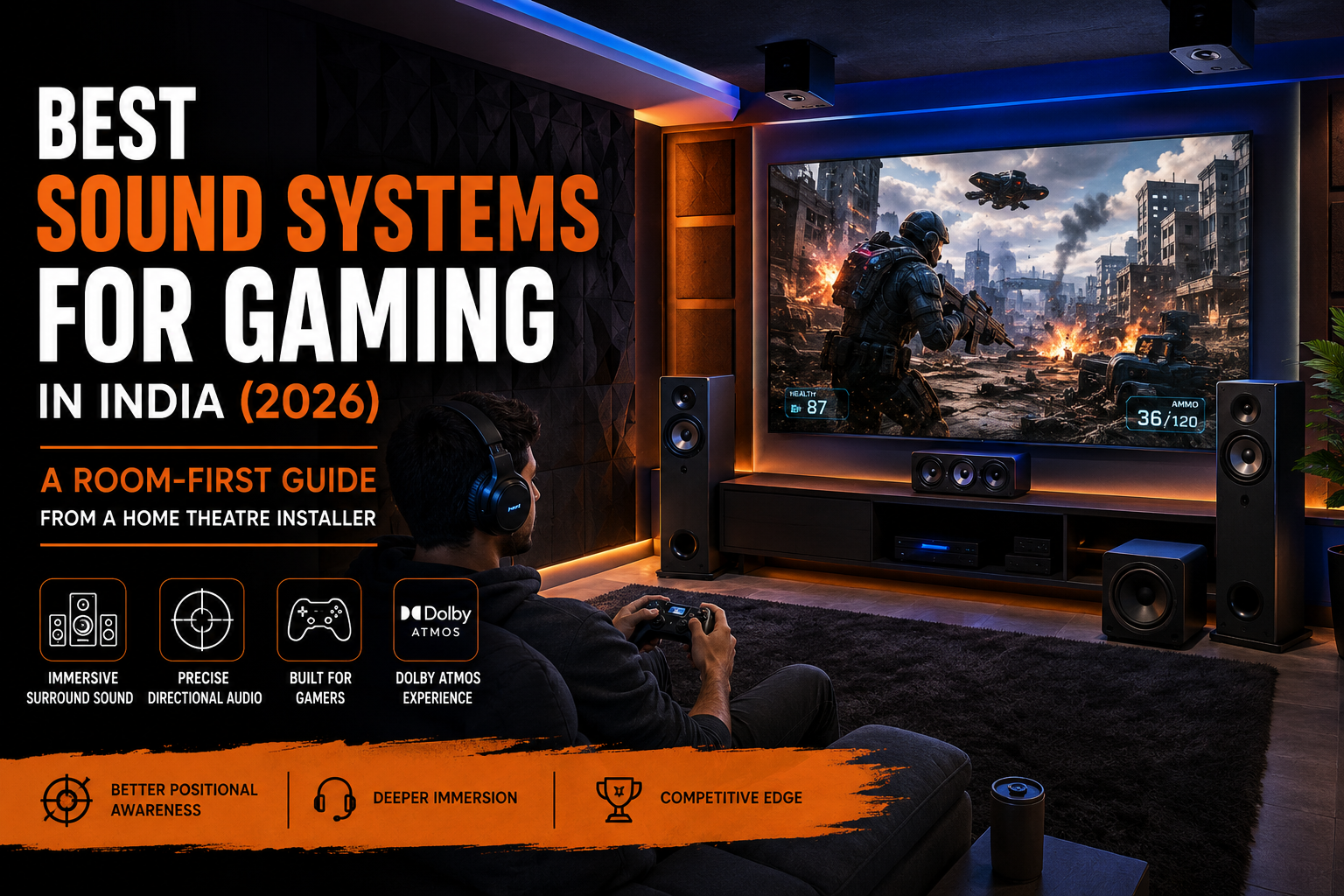
Best Sound Systems for Gaming in India (2026): A Room-First Guide from a Home Theatre Installer
Search "best speakers for gaming", and you'll get the same answer forty different ways: a listicle of desk speakers ranked by driver size and latency, written for someone in a studio apartment in another country, with an Amazon affiliate link at the bottom of every entry.
Search "home theatre setup", and you'll get the opposite problem — real installers, real ₹ pricing, real room photography, but gaming mentioned once, in an FAQ, as an afterthought to movies.
Neither answers the actual question a serious gamer in India is asking: what should I actually build, in my actual room, on my actual budget, so that games sound the way their designers intended?
That's what this guide is for.
First, decide what you're actually building
"Gaming audio" means two very different things, and most guides collapse them into one list. Sort yourself into one of these before you spend a rupee.
A desk rig. You sit close to your monitor, space is at a premium, and you want a tight stereo or 2.1 sound without a subwoofer eating your kneehole.
A gaming room. You've got a couch, a TV or projector, a console or a gaming PC connected to a proper screen, and you want the room itself to feel like part of the game — footsteps behind you, explosions you feel in your chest, dialogue you don't have to strain for. This is a home theatre problem, not a peripheral problem, and it's the one most "best gaming speakers" articles simply don't address.
Soundbar, 5.1, 7.1, or Dolby Atmos — what a gaming room actually needs
| Setup | Best for | What it gets right for gaming | Where it falls short |
| Soundbar (with sub) | Compact rooms, single TV setups, PS5/Xbox on eARC | Clean install, no wiring, decent directional cues from up-firing drivers | Rear/side imaging is simulated, not real — footsteps behind you sound approximate, not precise |
| 5.1 surround | Medium rooms (150–250 sq ft), dedicated gaming corner | True rear-channel separation — you can actually hear enemies behind you, not just a virtualised guess | No height channel, so vertical audio cues (flyovers, multi-storey combat) are flat |
| 7.1 surround | Larger rooms, wraparound seating | Wider rear/side field, better for open-world and racing titles | Diminishing returns in small rooms — speakers end up too close together to differentiate |
| Dolby Atmos (5.1.2 / 7.1.4) | Dedicated gaming/theatre rooms, ceiling height 8ft+ | Full 3D positional audio — the format most modern AAA titles are actually mixed for | Needs real room design: ceiling or upward-firing speakers, calibration, and a room that isn't fighting you acoustically |
The pattern competitors miss: the right choice depends on your room, not just your budget. A ₹1.5 lakh Atmos setup crammed into a small bedroom with hard walls and no acoustic treatment will sound worse than a well-placed, well-calibrated 5.1 system in the same space.
For a deeper look at how these formats compare outside of gaming specifically, see our full best surround sound system in India guide. If cable-free installs matter to you, our guide to picking the best wireless surround sound speaker system covers the trade-offs of going wireless.

PS5 and Xbox Series X: the connection details nobody in India explains clearly
If you're gaming on console rather than PC, get these three things right before you buy anything:
- HDMI eARC, not ARC. Your TV needs an eARC-labelled HDMI port to pass full-bitrate Dolby Atmos from the console through to your soundbar or receiver. A standard ARC port will quietly downgrade the signal, and you'll never notice why your ₹80,000 soundbar sounds thin.
- Set the console output correctly. Both PS5 and Xbox need their audio output manually set to Bitstream/Dolby Atmos in the system settings — it isn't always the default, even on Atmos-capable hardware.
- HDMI 2.1 passthrough, if you care about 4K/120Hz. If your soundbar or AV receiver sits between console and TV, confirm it passes 4K at 120Hz without forcing a lower refresh rate. Cheaper bars quietly cap this and gamers only discover it mid-match.
These are the details that separate a setup that looks right on a spec sheet from one that actually performs — and it's exactly the kind of thing our installers check during every gaming room consultation. If you're deciding between a receiver-based system and an all-in-one amplifier, our AV receiver vs amplifier guide breaks down which fits a gaming setup better, and our Dolby Atmos AV receiver guide for India covers Atmos-specific receiver requirements in detail.
Budget tiers for a real gaming room in India
Entry (₹40,000–₹80,000):
A quality Dolby Atmos soundbar with wireless sub and rear satellites. No wiring, works with any TV that has eARC, upgradeable later. Right choice if you're gaming in a shared living room, not a dedicated space. If you're working with a tighter budget still, our home theatre systems under ₹20,000 in India roundup covers the entry point below this tier.
Mid (₹1.5–₹4 lakh):
A 5.1 or 5.1.2 setup built around a proper AV receiver (Denon, Marantz, or Yamaha are common, reliable choices in the Indian market — see also how Bose, JBL, Sony, and Sonos compare if you're weighing an all-in-one system instead), with real rear channels and basic room calibration. This is the sweet spot for a dedicated gaming corner or spare room.
Premium (₹5 lakh+):
Full 7.1.4 Dolby Atmos with in-ceiling or upward-firing speakers, acoustic treatment, and professional room calibration — built for a dedicated gaming/theatre room where you want the format modern games are actually mixed for, done properly rather than approximated. Our home theatre packages in India page has a fuller breakdown of what's included at each tier.
Every one of these tiers benefits from the same thing a ₹15,000 desk soundbar never will: someone who has actually measured your room before recommending what goes in it. For a full cost breakdown by component, see our audio-video budgeting guide.
Where most gamers get speaker placement wrong
This is the part no affiliate review can give you, because it has nothing to do with which product you buy and everything to do with where you put it.
- Rear speakers too close to the seating position. For gaming, you want to actually perceive direction — footsteps from behind should sound like they're behind you, not right next to your ear. That's a placement problem, not a product problem.
- Subwoofer against a corner or wall. It'll sound louder, but boomier and less precise — exactly the opposite of what you want when you're trying to distinguish an explosion from a footstep.
- Ignoring your seating distance from the screen when setting channel levels. A calibration that's correct for someone sitting 8 feet back will sound wrong if you're actually gaming from 5 feet away on a couch pulled forward. Off-the-shelf "best speakers" lists can't account for this — a room visit can.
Browse the reference speakers we work with for gaming and movie rooms alike, and if echo or boomy bass is part of your problem, our acoustic wall panels for home cinema guide explains how room treatment fixes what speaker placement alone can't.
The bottom line
If you're upgrading your desk rig, a good pair of 2.1 speakers or a compact soundbar from any reputable brand will serve you well — the global gear review sites have that covered.
But if you're building an actual gaming room — a space where you want the audio to match the graphics, where footsteps, explosions, and dialogue all need to feel real rather than approximated — that's a room design and calibration problem as much as a shopping one. It's exactly what Nanotheatre has spent [X] years doing for movies, and the same expertise applies directly to gaming: room-aware speaker selection, real placement, and calibration tuned to how you actually sit and play.
Ready to build a gaming room that actually sounds like the game? Book a free consultation and we'll assess your space, your budget, and your setup — console or PC — before recommending a single speaker.
FAQs
Do I need Dolby Atmos for gaming, or is 5.1 enough?
5.1 is genuinely enough for most games and most rooms — it gives you real rear-channel separation, which is the biggest jump from stereo. Atmos adds height/vertical audio, which matters most in open-world and multi-storey titles, and needs a room with enough ceiling height (8ft+) to do it properly.
Can I use a home theatre system built for movies with my gaming console?
Yes, as long as it supports HDMI eARC (for Atmos passthrough) and, ideally, HDMI 2.1 passthrough if you want 4K/120Hz gaming. Most modern AV receivers and Atmos soundbars support both — but it's worth confirming before you buy.
Is a soundbar or a full surround system better for gaming?
A soundbar is the better choice for compact rooms, shared living spaces, or anyone who doesn't want visible wiring. A true 5.1/7.1 surround system is better if directional accuracy — actually hearing where a sound is coming from — matters to how you play. Competitive/FPS players tend to notice the difference more than casual or story-driven gamers.
How much does a proper gaming sound setup cost in India?
Entry-level Atmos soundbar setups start around ₹40,000–₹80,000. A proper 5.1 surround system with an AV receiver typically runs ₹1.5–₹4 lakh. Full Dolby Atmos rooms with acoustic treatment and ceiling speakers start from ₹5 lakh upward. (Confirm current figures before publishing.)
Comments (0)
No comments yet. Be the first to share your thoughts!
Leave a Comment