


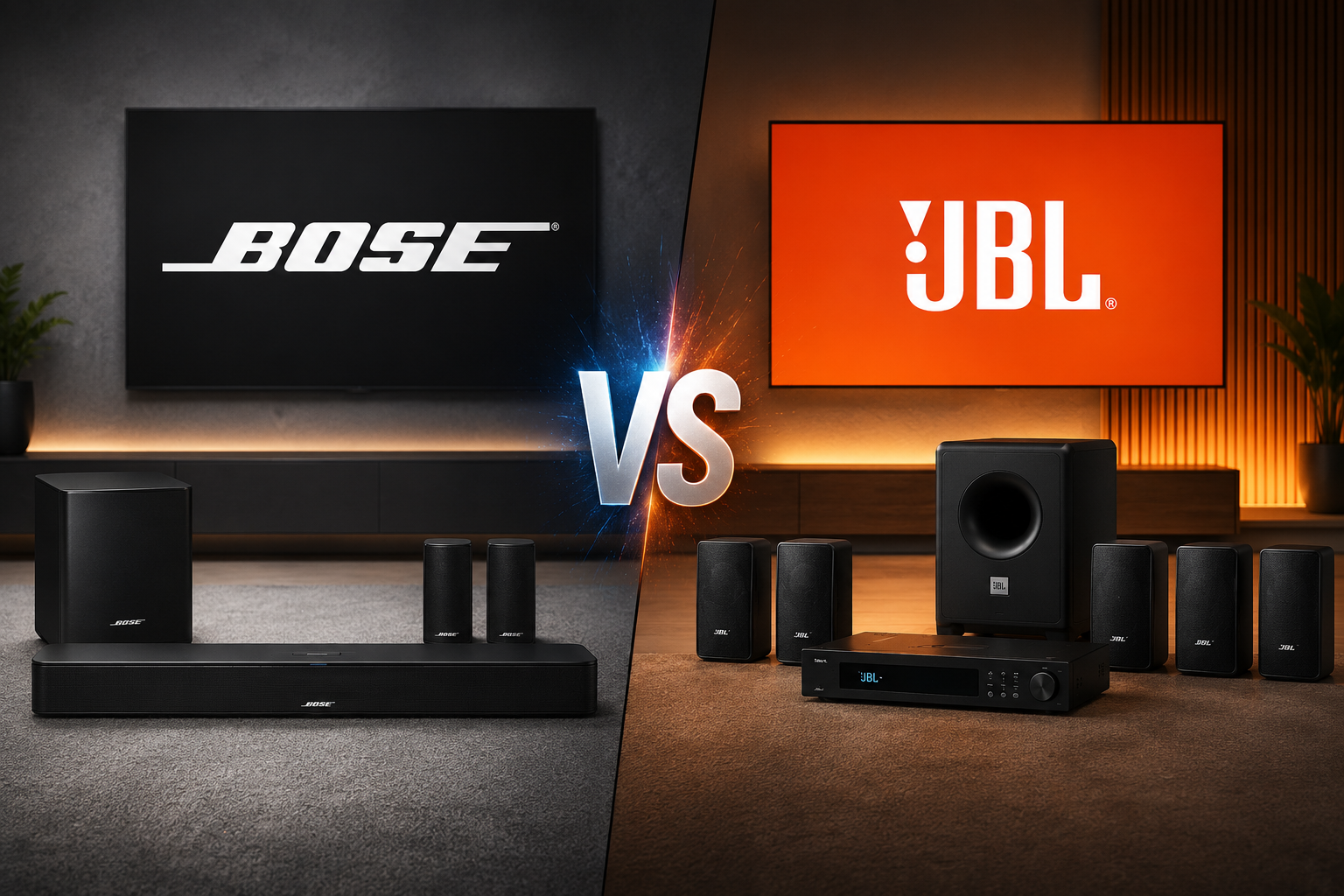
Bose vs JBL: Which Speaker Brand Should You Buy in 2026?
If you've spent any time shopping for a Bluetooth speaker, a pair of headphones, or a car audio upgrade, you've almost certainly landed in the middle of this debate. Bose and JBL are the two names that dominate nearly every "best speaker" list, and picking between them isn't as simple as checking star ratings — the two brands are built around genuinely different philosophies.
The short version: JBL leans into big, punchy, bass-forward sound, rugged builds, and aggressive pricing — it's the brand for parties, the outdoors, and people who want more speaker for less money. Bose leans into balance, refinement, and premium finish — it's the brand for people who want a smoother, more accurate sound signature and are willing to pay a bit more for it.
Neither brand is "better" in every category, and the right pick genuinely depends on what you're listening to, where you're listening to it, and how loud you like it. Below, we break the comparison down by category — portable speakers, Bluetooth speakers generally, car audio, headphones and earbuds, and soundbars — so you can find the section that actually matches what you're shopping for.
Quick Verdict: Bose vs JBL at a Glance
| Category | Sound Signature | Durability | Price Range | Best For | Edge Goes To |
| Portable Speakers | JBL: bold, bass-heavy / Bose: balanced, controlled | Both rated IP67/IP68 | Similar, JBL often cheaper | JBL for parties, Bose for refined listening | Tie — depends on taste |
| Bluetooth Speakers (general) | JBL: louder ceiling / Bose: cleaner at volume | Comparable | JBL usually better value | JBL for volume, Bose for clarity | JBL for value, Bose for polish |
| Car Audio | Bose: OEM-tuned integration / JBL: aftermarket punch | N/A | Bose often bundled, JBL upgrade kits vary | Bose for factory-installed systems | Bose |
| Headphones & Earbuds | Bose: refined ANC / JBL: longer battery, more features | Both solid | Comparable at flagship tier | Bose for noise cancelling, JBL for battery life & extras | Bose for ANC, JBL for endurance |
| Soundbars | Bose: cinematic clarity / JBL: home-theatre punch | N/A | Comparable | Bose for movies, JBL for bass-driven content | Slight edge to Bose |
Bose vs JBL: Brand Overview
JBL was founded by James Bullough Lansing in the 1940s and has spent decades as a fixture in professional touring and studio audio before becoming a household consumer name — it's now part of the Harman portfolio, which is owned by Samsung. That pro-audio DNA still shows up in JBL's consumer products: they're tuned to sound loud, exciting, and impactful, the same qualities engineers look for when designing speakers for concerts and clubs.
Bose, founded by Dr. Amar Bose in 1964, grew out of MIT-rooted acoustic engineering research rather than the touring circuit. The company has stayed privately held and has built its reputation on psychoacoustic research, noise cancellation technology, and a more restrained, "true to the source" approach to tuning. Bose products tend to prioritize clarity and comfort over raw impact.
Which is the No. 1 speaker brand?
There isn't a single, universally agreed "number one" — it depends on the metric. By global sales volume and product breadth, JBL (backed by Harman/Samsung's distribution) is generally considered the larger consumer audio brand. By brand reputation for premium engineering, noise cancellation, and customer loyalty in categories like headphones and home audio, Bose is typically ranked at or near the top. If you're going purely by portable Bluetooth speaker sales, JBL usually leads; if you're going by premium headphone reputation, Bose usually leads.
Bose vs JBL Sound Quality
This is the crux of almost every "which is better" question, so let's break it into its actual components rather than giving a vague answer.
Bass response: JBL consistently tunes for a heavier low end. Its speakers are voiced to make bass-forward genres — hip-hop, EDM, pop — feel punchy and physical, even in small enclosures. Bose tends to dial bass back slightly in favour of a flatter overall curve, which some listeners find more accurate but less exciting.
Mids and vocals: Bose speakers generally handle vocal-heavy content — podcasts, acoustic tracks, dialogue — with a bit more clarity, because the mid-range isn't being pushed aside by an emphasised low end. JBL's detailed mids can sound great at low-to-moderate volumes, but on some models the mids can turn slightly harsh once you push the volume up.
Loudness and distortion at volume: This is where JBL usually wins outright. JBL speakers are typically rated with higher RMS wattage than their closest Bose competitors in the same size class, and JBL's tuning is built to stay listenable at higher volumes without falling apart, though not always without some added edge in the treble.
EQ customisation: JBL's companion app typically ships with a more granular multi-band EQ, giving you finer control to tune the sound to your taste. Bose's app usually offers a simpler EQ, which suits people who trust the factory tuning but limits people who like to tweak.
The verdict: If you want a speaker that gets loud and stays exciting, JBL has the edge. If you want a speaker that sounds clean and controlled at any volume and handles vocals more naturally, Bose has the edge.
Bose vs JBL Portable & Bluetooth Speakers
This is the single biggest category driving the Bose-vs-JBL debate, and it's worth looking at the current flagship matchup directly: the JBL Flip 7 against the Bose SoundLink Flex (2nd Gen), both priced in the same bracket.
Power and loudness: The Flip 7 is rated at roughly 35 watts RMS versus the SoundLink Flex 2's 20 watts, and it noticeably out-volumes the Bose without falling apart, thanks to JBL's AI Sound Boost processing. If loudness is your priority, JBL wins this comparison clearly.
Sound signature at different volumes: At low-to-moderate volume, the Flip 7's detailed mids can actually edge out the Flex 2. But push both speakers toward their ceiling, and the story flips — the SoundLink Flex 2's more restrained tuning holds together better, while the Flip 7's pushed mids can start to sound harsh.
Durability: Both are built for abuse. The Flip 7 carries an IP68 rating (dustproof, submersible up to 1.5 meters), edging out the Flex 2's IP67 rating on paper. But the SoundLink Flex 2 floats, while the Flip 7 sinks — so for poolside or beach use where you might drop it in water, Bose's design is arguably the safer bet despite the "lower" rating.
Design and feel: The SoundLink Flex 2 uses a mix of soft-touch silicone and a metal grille that feels genuinely premium in hand. The Flip 7 goes the other direction, wrapped in tough fabric with rubber bumpers that make it feel purpose-built for camping trips and festivals rather than the coffee table.
Battery life: The Flip 7 has a slight edge, rated for around 14 hours of typical playback, extendable further with its PlaytimeBoost mode. The SoundLink Flex 2's battery life is competitive but doesn't quite match that ceiling.
Multi-speaker pairing: JBL's Flip 7 uses Auracast to link with other recent Auracast-enabled JBL speakers (like the Charge 6 or Xtreme 4), though it isn't backwards-compatible with older PartyBoost speakers like the Flip 6. Bose's SoundLink Flex 2 can link with compatible Bose soundbars via SimpleSync, but similarly isn't backwards-compatible with the original SoundLink Flex.
Calling and mic quality: This is an underrated differentiator — Bose speakers frequently include a built-in microphone for calls, a feature JBL's portable line doesn't always match.
The verdict for portables: Choose JBL if you want maximum volume, longer battery life, and a rugged, go-anywhere design at a slightly lower price. Choose Bose if you want a more refined sound at higher volumes, a premium in-hand feel, and a speaker that floats rather than sinks.
Bose vs JBL Car Speakers
Car audio is a genuinely different conversation from portable Bluetooth speakers, because the buying context is different. Bose has spent decades building deep OEM relationships with automakers, meaning a huge number of vehicles ship with a "Bose Premium Sound System" factory-integrated and tuned specifically for that car's cabin acoustics. This gives Bose a real advantage for anyone buying a new car with audio bundled into a trim package — the tuning is custom-matched to the vehicle, not a generic aftermarket install.
JBL, through Harman, also has OEM presence in some vehicles, but it's more commonly encountered in the aftermarket space — component speakers, subwoofers, and amplifiers that owners install themselves or through a car audio shop to upgrade a factory system. JBL's aftermarket car speakers tend to favor the same bass-forward, high-output character as its portable lineup.
The verdict: If you're evaluating a factory-installed system as part of a car purchase, Bose is usually the stronger, better-integrated option. If you're upgrading an existing car's speakers yourself and want maximum output for the money, JBL's aftermarket components are usually the better value play.
Bose vs JBL Headphones & Earbuds
Comparing the flagship over-ear models — Bose QuietComfort Ultra against JBL Tour One M3 — highlights how the brand personalities carry over into headphones.
Noise cancellation: Bose remains the benchmark. The QuietComfort Ultra's ANC is refined and consistently rated among the best in the industry for blocking low-frequency drone (engine noise, HVAC hum). JBL's Tour One M3 has closed the gap significantly and now performs close to flagship-level ANC from Sony and Bose, but Bose still holds a slight overall edge in the smoothness of its noise cancellation.
Battery life: JBL wins decisively here. The Tour One M3 has been independently tested at well over 50 hours of ANC-on playback, more than double what the Bose QuietComfort Ultra delivers in the same test conditions.
Connectivity and features: JBL's Tour One M3 includes a "Smart Transmitter" case that can plug into a 3.5mm jack (like an airplane seatback screen) and beam audio wirelessly to the headphones — a genuinely useful feature Bose doesn't offer. JBL also supports a wider range of codecs including LDAC for hi-res audio over Bluetooth.
Sound tuning: Bose tends to sound more neutral and vocal-forward out of the box. JBL's default tuning is more V-shaped and energetic, though JBL has shown a willingness to refine tuning post-launch via firmware updates based on listener feedback.
Earbuds: The same pattern holds for true wireless earbuds. Comparing the Bose QuietComfort Ultra Earbuds to the JBL Tour Pro 3, Bose again leans on refined, dependable ANC and a simpler feature set, while JBL packs in extras like a touchscreen charging case, Auracast sharing, and a six-microphone call setup that gives it a slight edge for calls in windy or noisy environments.
The verdict: Choose Bose for the best-in-class noise cancellation and a more neutral, natural sound. Choose JBL if all-day battery life and extra features (wireless transmitter, more advanced case, broader codec support) matter more to you than having the absolute best ANC on the market.
Bose vs JBL Soundbars
In home theatre, Bose soundbars are generally tuned for dialogue clarity and a wide, immersive soundstage — a natural extension of the brand's psychoacoustic research, and a strong pick if you watch a lot of dialogue-heavy content or movies. JBL's soundbar lineup, often paired with a dedicated wireless subwoofer, tends to deliver a more aggressive, bass-driven home theatre experience that suits action movies, gaming, and music-heavy content.
Both brands offer multi-room and multi-speaker pairing within their own ecosystems (Bose SimpleSync, JBL Auracast), so if you already own portable speakers from one brand, staying within that ecosystem for your soundbar makes multi-room setup considerably easier.
Bose vs JBL: Price & Value
Is JBL more expensive than Bose? Generally, no — JBL tends to be the more budget-friendly brand across most categories. At the entry level, JBL's Clip, Go, and Tune lines significantly undercut Bose's cheapest offerings. At the flagship level, the gap narrows considerably — top-tier portable speakers like the Flip 7 and SoundLink Flex 2 are often priced identically, and flagship headphones from both brands sit in a similar premium bracket. Where Bose consistently commands a premium is in noise-cancelling headphones and home theatre systems, where its reputation and refined tuning justify a higher asking price for many buyers.
The verdict: JBL generally offers more speaker (in terms of loudness, features, and battery life) per dollar at the low-to-mid tier. Bose's premium is most justified in ANC headphones and OEM car audio, where its engineering reputation is strongest.
JBL vs Bose vs Sony: How Does Sony Fit In?
Sony is the third major name that regularly comes up alongside this comparison, particularly in headphones. Broadly:
- For noise-cancelling headphones, Sony's flagship WH-1000X series is widely considered the closest rival to Bose's QuietComfort Ultra, often trading the top spot depending on the testing methodology — with Bose and Sony both generally regarded as ahead of JBL specifically on ANC performance, even as JBL closes the gap.
- For portable Bluetooth speakers, JBL and Bose remain the two names most commonly compared head-to-head; Sony has a smaller footprint in this specific category.
- For overall value, Sony tends to sit between the two — often pricier than JBL but with a feature set that can rival Bose in headphones specifically.
If you're choosing among all three, a reasonable rule of thumb is: JBL for loud, affordable, feature-packed portable audio; Bose or Sony for premium noise-cancelling headphones, with the final choice between those two coming down to fit preference and app ecosystem.
Pros and Cons Summary
Choose JBL if you want:
- Louder maximum volume and a bass-forward sound signature
- Longer battery life on flagship headphones and many portable speakers
- More granular EQ customisation
- Generally lower prices at the entry and mid tier
- Extra features like wireless transmitters and broader codec support
Choose Bose if you want:
- A smoother, more balanced sound that holds together at higher volumes
- Best-in-class noise cancellation for headphones and earbuds
- A more premium in-hand feel and build finish
- Strong factory-integrated car audio if you're buying a new vehicle
- A simpler, more dependable app experience over a deeply customizable one
Frequently Asked Questions
Is JBL as good as Bose?
For raw loudness, battery life, and value for money, JBL is arguably better than Bose in several product lines. For noise cancellation and refined, balanced sound at high volumes, Bose generally remains ahead. "As good as" really depends on which quality matters most to you.
Are JBL speakers better than Bose?
In terms of maximum output and bass impact, yes, JBL speakers are generally louder and punchier for the price. In terms of sound accuracy and performance at higher volumes without harshness, Bose speakers typically edge ahead.
Is Bose or JBL better for bass?
JBL. Its speakers and headphones are consistently tuned with a more emphasised low end, which is why JBL is the more common pick for hip-hop, EDM, and other bass-heavy genres.
Which is better for outdoor use, Bose or JBL?
Both brands offer rugged, water-resistant options suitable for outdoor use. JBL's higher IP68 rating on models like the Flip 7 gives it a slight durability edge on paper, but Bose's floating design on the SoundLink Flex 2 can be more practical for use near water.
Is JBL better than Bose for the price?
At the entry and mid-tier price points, yes — JBL typically delivers more volume, battery life, and features per dollar. At the flagship tier, the price gap narrows, and the decision comes down to sound preference rather than value.
What's the difference between JBL and Bose for headphones specifically?
Bose generally wins on noise cancellation and sound neutrality; JBL generally wins on battery life and bonus features like wireless transmitters and broader Bluetooth codec support.
Final Verdict: So, Which Should You Buy?
There's no single winner across the board — but there is a clear way to decide based on what you actually need:
- Buy JBL if you want a louder, bass-heavy sound, longer battery life, rugged durability, and strong value for money — especially for portable speakers and everyday headphones.
- Buy Bose if you want the most refined, balanced sound, best-in-class noise cancellation, a premium feel, and you're willing to pay a bit more for that polish — especially for ANC headphones and factory car audio.
If you're still torn, think about where you'll use it most. Taking speakers to the beach, camping, or a party? JBL's durability, volume, and battery life will serve you better. Working in a noisy office, commuting, or flying often? Bose's noise cancellation and refined tuning are worth the premium. Buying a new car? Check whether Bose is a factory option — it's usually the better-integrated choice.
Comments (0)
No comments yet. Be the first to share your thoughts!
Leave a Comment