


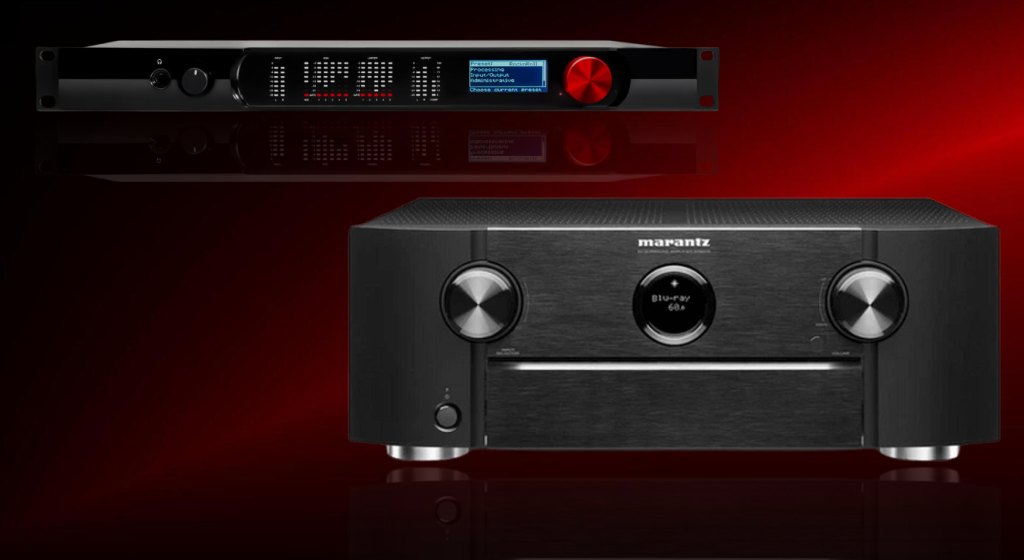
AV Receiver vs Amplifier: Which Is Better for Home Theatre?
For most home theatres, an AV receiver is the better choice — it handles surround sound, Dolby Atmos, video switching, and streaming in one box. A stereo amplifier is the better choice only if your priority is pure two-channel music listening rather than movies or gaming. Read on for exactly which one fits your setup.
If you're planning a home theatre, this is one of the first real decisions you'll face — and it's one that quietly shapes everything downstream, from how many speakers you can run to whether Dolby Atmos is even possible in your room. Both an AV receiver and an amplifier "power your sound," but they're built for different jobs.
At NanoTheatre, we've designed and installed hundreds of custom home cinema systems across India, and this exact question comes up in nearly every consultation. Here's the straight answer, backed by how these systems actually perform in real Indian homes.
What Is an AV Receiver?
An AV receiver (Audio Video Receiver) is the central control unit of a home theatre system. It processes both audio and video signals, decodes surround sound formats like Dolby Atmos and DTS:X, and powers your speakers — all from one device.
This is why AV receivers are the most common choice for Home Theatre Installation and Dolby Atmos Home Theatre setups: one box replaces what would otherwise be four or five separate components.
What Is an Amplifier?
An amplifier is a device built for one job: taking a line-level audio signal and boosting it enough to drive your speakers cleanly. A stereo amplifier does not process surround sound, does not switch video, and does not decode Dolby Atmos — it simply amplifies two channels of audio as accurately as possible.
That narrow focus is exactly its advantage. Because an amplifier isn't juggling video processing, HDMI switching, and multiple channels at once, its circuitry can be optimised purely for clean, detailed sound — which is why serious music listeners often prefer one over a receiver.
AV Receiver vs Amplifier: Quick Comparison
| Use cases | AV Receiver | Amplifier |
| Best for | Movies, Dolby Atmos, gaming, streaming | Two-channel music, hi-fi listening |
| Channels | Typically 5.1 to 11.2+ | Usually 2 (stereo) |
| Video processing / HDMI switching | Yes | No |
| Surround sound decoding (Atmos, DTS:X) | Yes | No |
| Streaming & smart features | Usually built-in | Rarely, unless a modern integrated amp |
| Sound purity for music | Very good | Best-in-class |
| Ideal setup | Full home theatre | Dedicated music room |
The one-line answer: if your system needs to handle a screen, choose an AV receiver; if it only needs to handle music, choose an amplifier.
AV Receiver vs Preamp/Processor: What's the Difference?
This is a related question we get almost as often, and it's worth answering directly: an AV receiver combines two things — a processor (which decodes audio/video formats and switches sources) and power amplification (which actually drives your speakers) — in a single box.
A preamp/processor (pre/pro) setup splits these two jobs apart: the processor handles all the decoding and switching, then sends a line-level signal out to one or more separate power amplifiers. This is a "separates" system.
- Choose an AV receiver if you want a simpler, more affordable, all-in-one setup — this covers the vast majority of home theatres.
- Choose a preamp/processor + separate power amps if you're building a high-end, dedicated cinema room and want the flexibility to upgrade the processor or amplification independently, or need more clean power than a receiver's built-in amps can deliver.
For most homeowners, this level of complexity isn't necessary — it's really a step reserved for advanced Luxury Home Theatre builds where every component is being optimised individually.
Which Should You Choose?
- You need an AV receiver if: you're building a home theatre around a screen, want Dolby Atmos or DTS:X, plan to connect a gaming console or streaming device, or want one device to control everything.
- You need an amplifier if: your system is built primarily for music, you already have a separate source for video, or you're chasing the cleanest possible two-channel sound for a dedicated listening room.
- You may need both if: you want a full home theatre and audiophile-grade music playback — many advanced setups use an AV receiver for movies and video switching, paired with a dedicated stereo amplifier for the front left/right channels during music playback.
Higher wattage does not automatically mean better sound — room acoustics affect audio performance more than most people expect, and even a premium receiver will sound poor in an untreated room. This is why Home Theatre Acoustic Treatment matters as much as the electronics themselves.
Real-World Examples by Budget Tier
To make this less abstract, here's roughly how the choice plays out across different budget levels:
- Entry-level home theatre: A 5.1 or 7.1-channel AV receiver (e.g., from Denon's AVR-X series or a Yamaha equivalent) is typically the right starting point — enough channels for a genuine surround setup without paying for capability you won't use.
- Mid-range home theatre: A 7.2 or 9.2-channel AV receiver with Dolby Atmos height channel support (Denon, Marantz, or Yamaha Aventage-tier) covers most dedicated home theatre rooms comfortably.
- Premium/audiophile music setup: A dedicated integrated amplifier (NAD, Cambridge Audio, or similar) paired with quality source equipment, for listeners prioritizing music over cinema.
- Advanced luxury cinema rooms: A pre/pro processor (e.g., Anthem or similar) combined with separate multi-channel power amplifiers — used when a project needs more clean power or flexibility than a receiver's internal amplification can provide.
A common mistake we see: homeowners buying an 11-channel receiver "to be safe" when their room and speaker layout will only ever use 7. More channels aren't better if you're not using them — they add cost without adding to the experience.
Design Your Home Theatre Before You Buy Anything
Before deciding between a receiver and an amplifier, it helps to actually see what your room can support — how many speakers it can realistically fit, where they'd go, and whether Dolby Atmos height channels are even possible in your space.
Try NanoTheatre's free interactive home theatre design tool. Enter your room dimensions, seating preferences, and entertainment goals, and within minutes you'll get a personalised layout showing what your ideal setup could actually look like — before you commit to any equipment. It's the fastest way to know whether you need a 5.1 receiver, a full Atmos setup, or something in between.
Try the free Home Theatre Planner →
Frequently Asked Questions
What is an AV receiver?
An AV receiver is the central hub of a home theatre system — it processes audio and video signals, decodes surround sound formats like Dolby Atmos and DTS:X, and powers your speakers, all in one unit.
What is an amplifier?
An amplifier is a device that boosts a line-level audio signal enough to drive speakers. Unlike an AV receiver, it doesn't process video or decode surround sound — it focuses purely on clean audio amplification, usually for two-channel (stereo) systems.
Is an AV receiver the same as a home theatre receiver?
Yes — "AV receiver" and "home theatre receiver" refer to the same type of device. Both terms describe a unit that combines audio processing, video switching, and amplification for a home cinema setup.
Does a receiver or amplifier sound better?
For pure two-channel music, a dedicated stereo amplifier generally sounds cleaner, since its circuitry isn't shared with video processing and multi-channel decoding. For movies and surround sound, an AV receiver's built-in processing makes it the practical — and often the only — choice.
Do I need a receiver for surround sound?
Yes. A standard amplifier cannot decode surround sound formats like Dolby Atmos or DTS:X — you need an AV receiver (or a separate processor) to create a true surround sound experience.
Can I use an amplifier with an AV receiver?
Yes. Many advanced home theatres pair an AV receiver (for video switching and surround processing) with a separate stereo amplifier (for higher-fidelity front left/right music playback). The receiver handles the movie experience; the amplifier sharpens the music experience.
What's the difference between an AV receiver and a preamp/processor?
An AV receiver combines processing and power amplification in one unit. A preamp/processor separates these — the processor handles decoding and switching, then sends signal to separate power amplifiers. Separates offer more flexibility and headroom but cost significantly more and suit advanced, dedicated cinema builds.
How many channels do I actually need?
Most home theatres are well served by a 5.1 or 7.1-channel receiver. Larger, dedicated rooms building toward full Dolby Atmos immersion may need 9 or more channels. Buying more channels than your room and speaker layout will use adds cost without adding to the experience.
Written by Pankaj Kumar, Home Theatre Design Lead at NanoTheatre, with 7+ years designing custom AV systems across India.
Ready to Design Your System?
Whether you land on an AV receiver, an amplifier, or both, the right choice starts with understanding your room. Try our free design tool above, or book a consultation with a NanoTheatre designer to get a system built around your actual space — not a generic recommendation.
Comments (0)
No comments yet. Be the first to share your thoughts!
Leave a Comment