


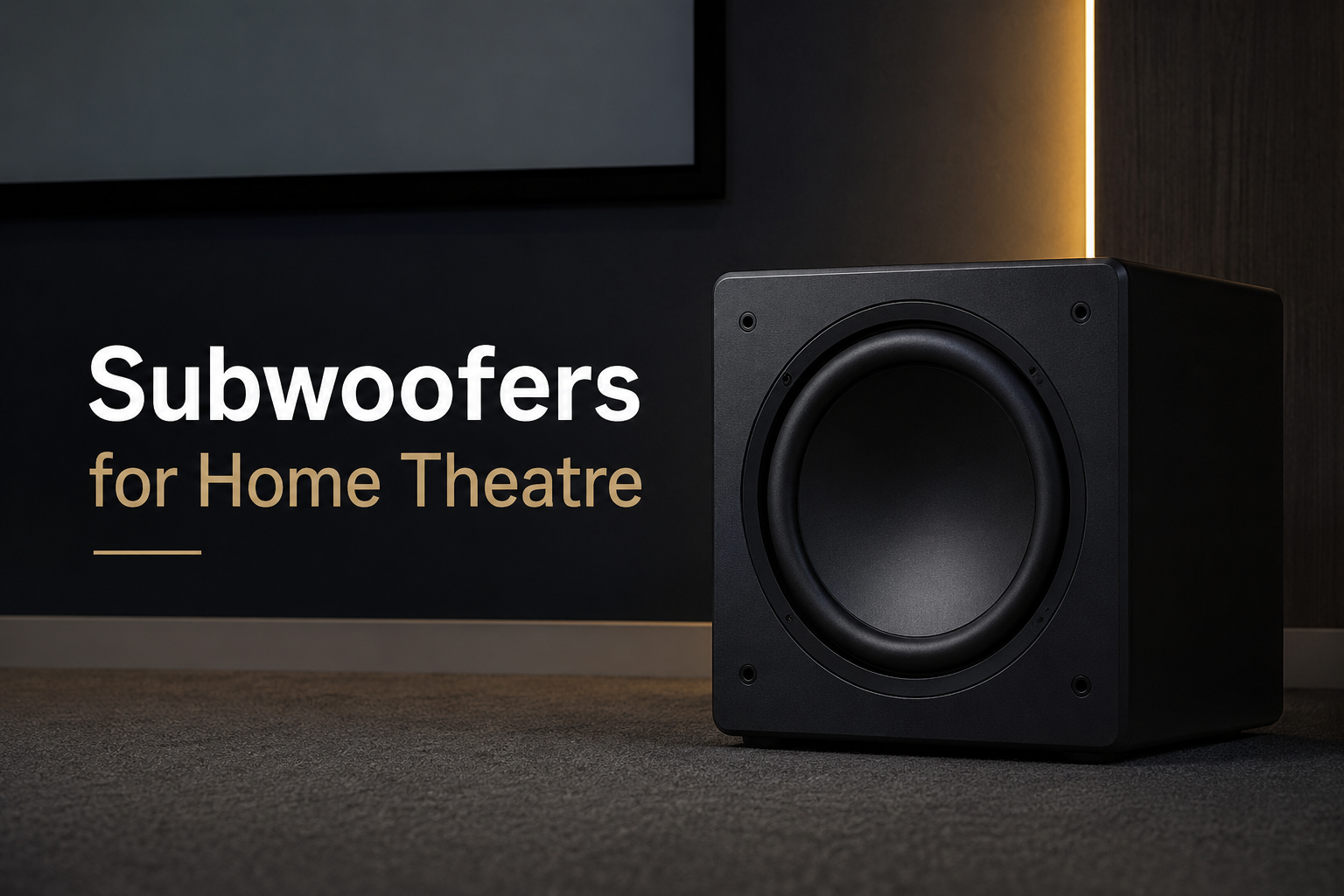
Why a Subwoofer Is the One Component You Shouldn't Skip
Every other speaker in your home theatre is working with a handicap: physics. A floorstanding speaker, a soundbar, even a full 7.1 surround setup — none of them can move enough air to reproduce true low-frequency sound. Most start rolling off somewhere below 40–50Hz, right where the weight of an explosion, the rumble of a passing train, or the low end of a film score actually lives.
That's the entire job of a subwoofer: to pick up everything your other speakers physically can't reproduce, typically in the 20Hz–200Hz range. Get it right and you don't just hear bass — you feel it. Get it wrong (undersized, badly placed, mismatched to the room) and it's the single most common reason an otherwise expensive home theatre still feels flat.
This guide walks through everything that actually matters when choosing one for an Indian home — driver size, power, sealed vs ported design, powered vs passive, what a realistic budget looks like, and how professional placement and calibration change the outcome more than most people expect. If you're starting from scratch and haven't settled on the rest of your setup yet, it's worth reading our home theatre systems guide first — a subwoofer is only ever as good as the system it's part of. And if you're weighing a soundbar instead of a full setup, our soundbar and subwoofer combos guide covers when a bundled sub is enough and when it isn't.
What to Look for When Buying a Subwoofer
1. Driver Size and Type
Subwoofer drivers typically range from 8 to 15 inches for residential use, with 10–12 inches being the sweet spot for most Indian living rooms and dedicated media rooms. Larger drivers move more air and dig deeper into low frequencies; smaller drivers are easier to place and blend into a room without dominating it visually.
The enclosure design matters as much as the driver itself:
- Sealed cabinets give tighter, more accurate bass with quick response — better for music and for rooms where the sub can't be placed in an ideal spot.
- Ported cabinets use a tuned vent to extract more output from the same driver and power level — better suited to larger rooms and the deep, sustained bass effects in movies.
2. Power (RMS, Not Peak)
Ignore peak wattage figures on packaging — they're marketing numbers. What matters is RMS (Root Mean Square) power, the continuous output the amplifier can sustain. For most Indian home theatre rooms, 100–300W RMS is sufficient; larger dedicated theatre rooms or higher-output preferences push into the 400–600W range.
3. Frequency Response
Look for a subwoofer that extends to at least 20Hz for genuine low-frequency reproduction — this is what captures the full range of a film's LFE (low-frequency effects) channel rather than just adding "thump." A flatter response curve across that range means more accurate, less boomy bass.
4. Connectivity
Most modern subwoofers connect via RCA/LFE input from an AV receiver — this covers the vast majority of home theatre setups. Some premium models add wireless connectivity, which is genuinely useful in situations where running a cable to the ideal placement spot isn't practical (a common scenario in renovated or rented Indian apartments where drilling isn't an option).
5. Cabinet Construction and Climate
Cabinet material and bracing quality directly affect bass tightness — look for MDF (Medium Density Fiberboard) construction with internal bracing to reduce unwanted resonance. In India specifically, humidity and heat cycling can affect cheaper cabinets over time, so moisture-resistant finishing is worth checking, particularly for units placed near windows or in non-climate-controlled rooms.
6. Placement Flexibility
Front-firing subwoofers generally perform best placed along the front wall, near the main speakers; down-firing designs tend to suit corner placement better. This matters more than most buyers expect — the same subwoofer can sound dramatically different depending on where it sits in the room, which is why placement and calibration are usually the difference between a subwoofer that sounds "fine" and one that disappears seamlessly into the mix. We cover this in detail in our subwoofer placement guide.
7. Price and After-Sales Support
[CONFIRM] In the Indian market, subwoofers span roughly ₹15,000 at the entry level to ₹5,00,000+ for reference-grade units. Whatever you buy, confirm warranty length and the availability of authorized service in your city before purchase — this matters more with subwoofers than almost any other component, since they're the least likely to get swapped out for years once installed.
What Size Room Needs What Size Subwoofer
| Room type | Typical size | Recommended driver | Notes |
| Living room / apartment | Up to ~150 sq ft | 8"–10" sealed | Compact footprint, easier to blend into a shared living space |
| Mid-size dedicated media room | ~150–250 sq ft | 10"–12" | Most common configuration for Indian home theatres |
| Large dedicated theatre room | 250–400+ sq ft | 12"–15", or dual subs | A single sub often can't distribute bass evenly at this size |
| Luxury multi-seat theatre | 400+ sq ft | Dual or triple sub arrays | Multiple subs flatten bass response across every seat, not just the "sweet spot" |
For a closer look at how driver size trades off against room size, see our 8" vs 10" vs 12" subwoofers comparison guide. And if you're planning a room from scratch rather than retrofitting one, our Design Theatre tool will map recommendations like this directly onto your actual room dimensions — more on that below.
Powered vs Passive: Which Do You Actually Need?
Almost every subwoofer sold for home use today is powered (also called "active") — it has a built-in amplifier matched to the driver, so it just needs a line-level input from your AV receiver. This is the right choice for the overwhelming majority of home theatre owners: simpler wiring, easier setup, and the amplifier is purpose-tuned to the driver.
Passive subwoofers — driven by an external amplifier — show up mainly in two situations: high-end custom installations where an installer wants full control over amplification and crossover behavior, and in-wall/in-cabinet builds where a passive design integrates more cleanly into custom cabinetry. If you're not doing a custom install, powered is almost certainly the right call.
(Full breakdown, including when a passive setup genuinely outperforms a powered one, in our dedicated powered vs passive subwoofers guide.)
What a Subwoofer Actually Costs in India (By Budget Tier)
Nano Theatre structures home theatre projects across three budget bands, and subwoofer selection scales with them:
Below ₹5 Lakh (overall project budget) A single quality 8"–10" powered subwoofer, sized to a living-room or compact media room installation. [CONFIRM exact allocation — typically 15–20% of total project budget]
₹5–10 Lakh A 10"–12" subwoofer matched to a proper AV receiver and full speaker array, often the point where sealed vs ported and precise placement start to matter more, since the rest of the system is capable enough to expose the difference.
Above ₹10 Lakh This is where dual-subwoofer setups, reference-grade drivers, and passive/custom-amplified configurations come in — bass output engineered for even response across every seat in the room, not just one sweet spot.
Wherever you land, the honest advice is the same: a subwoofer is one of the highest-impact upgrades in a home theatre budget, and one of the easiest to get wrong without proper placement and calibration — which is where installation expertise matters more than the spec sheet.
Want model-level recommendations at each of these tiers? See our roundup of the best subwoofers for home theatre in India.
Frequently Asked Questions
What is the minimum subwoofer frequency response I need for home theatre?
Look for extension to at least 20Hz. This captures the full range of a film's low-frequency effects channel rather than just adding generic "thump."
Do I need a subwoofer if I already have large floorstanding speakers?
Yes, in almost every case. Most floorstanding speakers start rolling off below 40–50Hz — a subwoofer fills that gap and adds impact that even large main speakers can't reproduce on their own.
Can one subwoofer handle a large room, or do I need more than one?
A single subwoofer is generally sufficient up to around 250–300 sq ft. Beyond that, dual subwoofers placed at different points in the room give far more even bass response across all seating positions, not just the primary listening spot.
Is a more expensive subwoofer always better?
Not necessarily. A well-placed, properly calibrated mid-range subwoofer will outperform an expensive one that's poorly positioned. Size and price should be matched to your room, not maximised for their own sake.
Should I buy online or through an installer?
Buying through an authorised dealer or installer ensures warranty validity and, more importantly, correct placement and calibration — the two factors that determine whether a subwoofer sounds seamless or sounds like a separate speaker bolted onto the room.
Get It Installed Right — Talk to Nano Theatre
A subwoofer on a spec sheet and a subwoofer that disappears into a room, sounding like it was never a separate speaker at all, are two very different outcomes. The gap between them is placement, calibration, and matching it correctly to your AV receiver and the rest of your system — not the price tag alone.
Nano Theatre designs and installs home theatre systems across India, from single-room living space upgrades to dedicated luxury theatres. If you're planning a new system or adding a subwoofer to an existing one:
See It Before You Build It: Try the Design Theatre Tool
Reading about driver sizes and room dimensions only gets you so far — the real question is what actually fits your room. That's exactly what our Design Theatre tool is built for.
Design Your Dream Theatre — in 3D, Before You Spend a Rupee
Nano Theatre's interactive Dolby Atmos planner lets you configure your room dimensions, seating layout, speaker placement, and acoustics — including subwoofer sizing and positioning — and see the result rendered in 3D, instantly.
What you can do with it:
- Customise your own theatre — input your actual room dimensions and get a tailored layout, including recommended subwoofer size and placement for your specific space → Start Custom Design
- Browse preset configurations — explore three curated tiers (Signature, Prestige, and Atelier) to see what's possible at different budget levels before customizing your own → View Preset Gallery
It takes the guesswork out of everything this guide just walked through — instead of estimating whether a 10" or 12" subwoofer fits your room, you can see it laid out against your actual dimensions.
The generated layout is for conceptual planning — our specialists finalize every design after evaluating your room's structural conditions, acoustics, and electrical requirements in person.
Comments (0)
No comments yet. Be the first to share your thoughts!
Leave a Comment