


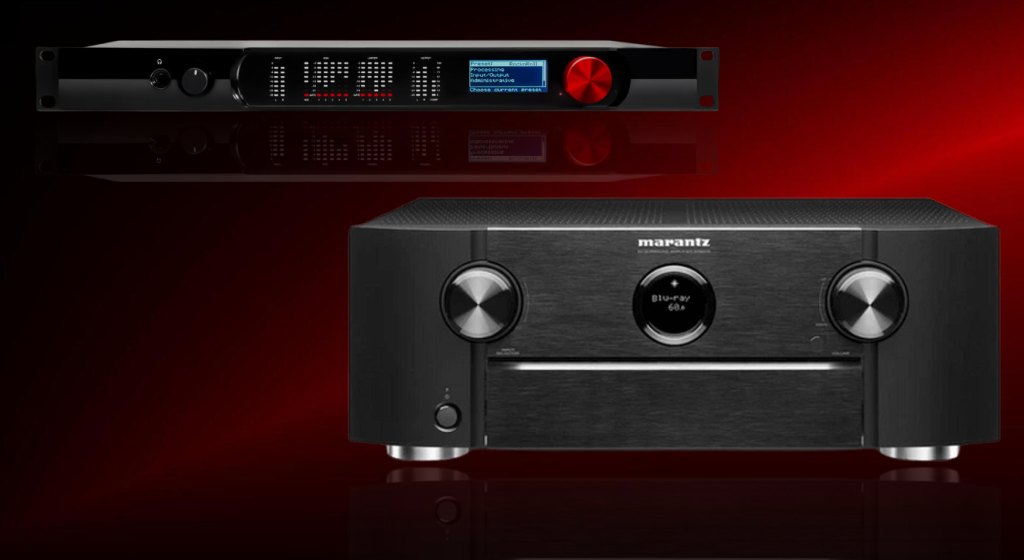
AV Receiver vs Amplifier: Which Is Better for Home Theatre?
If you’re planning a home theatre setup, one of the biggest decisions you’ll face is choosing between an AV receiver and a separate amplifier.
Both play a major role in your sound system, but they are designed for very different purposes.
An AV receiver is an all-in-one control center built for surround sound, Dolby Atmos, gaming, streaming, and modern home cinema setups. An amplifier focuses purely on powering speakers and delivering higher-quality audio performance.
So which one should you buy?
The answer depends on:
- your room size
- your budget
- your sound expectations
- your speaker setup
- whether you prioritize movies or music
At NanoTheatre, we’ve designed and installed hundreds of custom home cinema systems across India, and we’ve seen firsthand how the right audio electronics can completely transform a theatre experience.
In this guide, we’ll explain:
- the difference between AV receivers and amplifiers
- which is better for home theatre
- which delivers better music quality
- when to upgrade to a separate amplifier
- common buying mistakes to avoid
Quick Comparison: AV Receiver vs Amplifier
| Feature | AV Receiver | Amplifier |
| Surround Sound Support | Yes | No |
| Dolby Atmos / DTS:X | Yes | No |
| HDMI Connectivity | Yes | No |
| Gaming Console Support | Yes | Limited |
| TV Integration | Yes | No |
| Music Quality | Very Good | Excellent |
| Ease of Setup | Easy | Advanced |
| Best For | Home Theatre | Audiophile Music |
| Room Calibration | Yes | No |
| Multi-Speaker Setup | Yes | Limited |
What Is an AV Receiver?
An AV receiver (Audio Video Receiver) is the central control unit of a home theatre system.
It processes both audio and video signals while also powering your speakers.
Modern home theatre AV receivers support:
- Dolby Atmos
- DTS:X
- HDMI eARC
- 4K/8K passthrough
- gaming consoles
- streaming devices
- multi-room audio
A receiver allows you to connect:
- TVs
- projectors
- PlayStation/Xbox
- streaming devices
- Blu-ray players
- surround sound speakers
into a single integrated system.
This is why AV receivers are the most common choice for Home Theatre Installation and Dolby Atmos Home Theatre setups.
What Does an Amplifier Do?
An amplifier is designed specifically to amplify audio signals and power speakers.
Unlike an AV receiver, a home theatre amplifier does not:
- process video
- switch HDMI inputs
- decode Dolby Atmos
- manage surround sound formats
Its primary goal is:
pure audio performance.
Because amplifiers focus only on sound reproduction, they often deliver:
- cleaner audio
- higher power output
- better channel separation
- more refined music playback
This makes them popular among:
- audiophiles
- hi-fi enthusiasts
- dedicated music listening rooms
High-end amplifiers are commonly used alongside:
- AV processors
- stereo preamps
- premium floor-standing speakers
in advanced Home Audio Systems.
AV Receiver vs Amplifier: Main Differences
1. Surround Sound Capability
AV receivers are specifically designed for surround sound home theatre systems.
They support:
- 5.1 surround sound
- 7.1 surround sound
- Dolby Atmos
- DTS:X
Amplifiers alone cannot process surround sound formats.
If your goal is immersive cinema audio, an AV receiver is essential for a proper Surround Sound System.
2. HDMI & Video Support
One of the biggest advantages of an AV receiver is HDMI integration.
Modern receivers support:
- HDMI eARC
- 4K passthrough
- 8K passthrough
- gaming features
- video switching
Amplifiers do not handle video signals.
For projector-based Home Cinema Design setups, an AV receiver is typically the better solution.
3. Music Quality
Amplifiers generally deliver:
- better stereo imaging
- cleaner sound
- stronger dynamics
- more detailed music reproduction
This is because all their engineering focuses on audio quality rather than video processing.
If your primary goal is high-fidelity music listening, a stereo amplifier may outperform an AV receiver.
4. Ease of Installation
AV receivers are significantly easier to install.
They combine:
- amplification
- processing
- switching
- calibration
into one device.
Amplifier-based systems require:
- separate processors
- advanced wiring
- manual tuning
- additional calibration
For most homeowners, AV receivers provide a more practical and user-friendly solution.
Which Is Better for Home Theatre?
For most home theatre setups:
An AV receiver is the better choice.
Why?
Because a receiver is specifically built for:
- movies
- streaming
- gaming
- Dolby Atmos
- multi-speaker surround sound
At NanoTheatre, most of our Home Theatre Solutions use AV receivers because they offer:
- easier integration
- excellent performance
- future-ready connectivity
- simplified upgrades
Modern receivers also include:
- room correction software
- speaker calibration
- bass management
- acoustic optimization
which dramatically improve performance inside real Indian living rooms and media rooms.
Which Is Better for Music?
If your primary focus is:
- stereo music listening
- vinyl playback
- audiophile sound quality
then a dedicated amplifier may deliver superior performance.
Amplifiers are especially useful when paired with:
- premium bookshelf speakers
- floor-standing speakers
- high-end DACs
- acoustic treatment
Many audiophiles combine amplifiers with Acoustic Panels and Hi-Fi Speaker Systems to create highly detailed listening environments.
AV Receiver vs Amplifier for Dolby Atmos
Dolby Atmos requires:
- surround processing
- height channel decoding
- HDMI audio handling
This means:
you need an AV receiver or AV processor.
A standard amplifier alone cannot decode Dolby Atmos audio tracks.
For immersive Dolby Atmos Home Theatre systems, an AV receiver is the foundation of the setup.
When Should You Upgrade to a Separate Amplifier?
You should consider adding a separate amplifier when:
- your room is very large
- your speakers require more power
- you want higher sound pressure levels
- you notice distortion at high volume
- you want better music performance
Many premium home cinemas combine:
- an AV receiver
- external amplifiers
- dedicated subwoofer amplification
for superior performance.
This is common in advanced Luxury Home Theatre projects.
Common Buying Mistakes to Avoid
Buying Based Only on Wattage
Higher wattage does not always mean better sound quality.
Ignoring Room Acoustics
Room acoustics heavily impact audio performance.
Even expensive receivers can sound poor in untreated rooms.
This is why Home Theatre Acoustic Treatment matters.
Choosing Too Many Channels
Many homeowners buy 11-channel receivers without actually needing them.
The right setup depends on:
- room size
- seating layout
- speaker placement
Ignoring Future Connectivity
Choose receivers with:
- HDMI 2.1
- eARC
- 4K/120Hz gaming support
- Dolby Atmos
- streaming support
to future-proof your setup.
AV Receiver vs Amplifier: Which One Should You Buy?
Choose an AV receiver if:
- you want surround sound
- you watch movies regularly
- you use gaming consoles
- you want Dolby Atmos
- you prefer easy setup
Choose an amplifier if:
- you prioritize music quality
- you want audiophile sound
- you already own a processor
- you are building a high-end stereo system
For most homeowners building a complete Home Theatre Setup, an AV receiver is the ideal starting point.
Frequently Asked Questions
What is the difference between an AV receiver and an amplifier?
An AV receiver processes both audio and video signals while also powering speakers. An amplifier only amplifies audio signals.
Is an AV receiver better for home theatre?
Yes. AV receivers are specifically designed for surround sound home cinema systems.
Do I need an AV receiver for Dolby Atmos?
Yes. Dolby Atmos requires audio decoding that standard amplifiers cannot perform.
Can I connect an amplifier to an AV receiver?
Yes. Many advanced home theatres use external amplifiers alongside AV receivers.
Which is better for music: AV receiver or amplifier?
Amplifiers usually provide better stereo music quality and cleaner sound reproduction.
Are AV receivers good for gaming?
Yes. Modern AV receivers support:
- HDMI 2.1
- 4K/120Hz
- VRR
- low-latency gaming
What size AV receiver do I need?
It depends on:
- room size
- speaker count
- power requirements
- future expansion plans
Final Thoughts
Choosing between an AV receiver and amplifier depends entirely on your entertainment goals.
For most modern home theatre setups, an AV receiver delivers the best balance of:
- performance
- surround sound
- gaming support
- Dolby Atmos compatibility
- convenience
For dedicated audiophile music systems, separate amplifiers can provide higher levels of refinement and power.
At NanoTheatre, we help homeowners design custom Home Theatre Systems based on:
- room acoustics
- speaker matching
- cinema performance
- future scalability
Whether you’re building a compact media room or a luxury cinema space, the right audio foundation makes all the difference.
Comments (0)
No comments yet. Be the first to share your thoughts!
Leave a Comment